
Baked my first sourdough bread
- Mar 29, 2020
- 3 min read
I have been planning to make my own sourdough bread for several years, encouraged on by Iain and Doug's example. I had purchased a dough scraper and James Morton's, Super Sourdough book earlier this year. This was long before the current lockdown was even thought about. The current crisis has prompted me to have a go, mainly because the supply of my favourite artisan bread has been interrupted. Sourdough is how our ancestors have been making bread since we invented bread, so I reckoned it can't be that difficult.

Just over a week ago I got my starter going. For anyone who doesn't know what a sourdough starter is let me explain. Normal bread is made by adding industrially manufactured bakers yeast to flour, water and salt. The yeast consumes some of the sugars in the flour releasing carbon dioxide gas, which causes bubbles to form in the dough making it rise. Bakers yeast is very fast acting, therefore bread can be made in a couple of hours. Sourdough uses wild yeast naturally present in the flour and any yeast that happens to be floating in the atmosphere. To get enough wild yeast to make bread you need to capture it and grow it in a 'starter'.

To make a starter I mixed equal amounts of flour and water in a big jar and left it to ferment at room temperature for about a week. If you are lucky it starts to bubble after about 4 days and then you feed the yeast with more flour and water at about day 6 and then you are ready to bake on day 7. I was lucky to get a good starter going on my first attempt. Yesterday, my starter was ready so I decided to have a go at making bread.
I started at midday by mixing my strong bread flour (the best flour for making bread) with some of my yeast starter mix and some tepid water. After half an hour I mixed in the required amount of salt and started to knead the dough. This was a bit scary at first because it starts very sticky and I thought 'how will this ever form into a dough' but after about a couple of minutes of folding and stretching, it started to change consistently from a wet goo into something firm and workable. Now ten minutes of kneading sound like an effort but in reality it is not hard work and feels quite therapeutic and I ended up with a round tight ball of dough, which I left in a covered bowl at room temperature for 4 hours to prove (rise).

The next step was to split the dough into two pieces and give it a few more stretches and then shape them into balls ready for their second prove. This sounds tricky but it turned out to be fairly simple after watching a couple of Youtube videos. For the second proving, I lined a couple of baskets with grease proof paper and dropped the dough balls in, covering them for 3 more hours with a tea towel. They were then ready to bake.
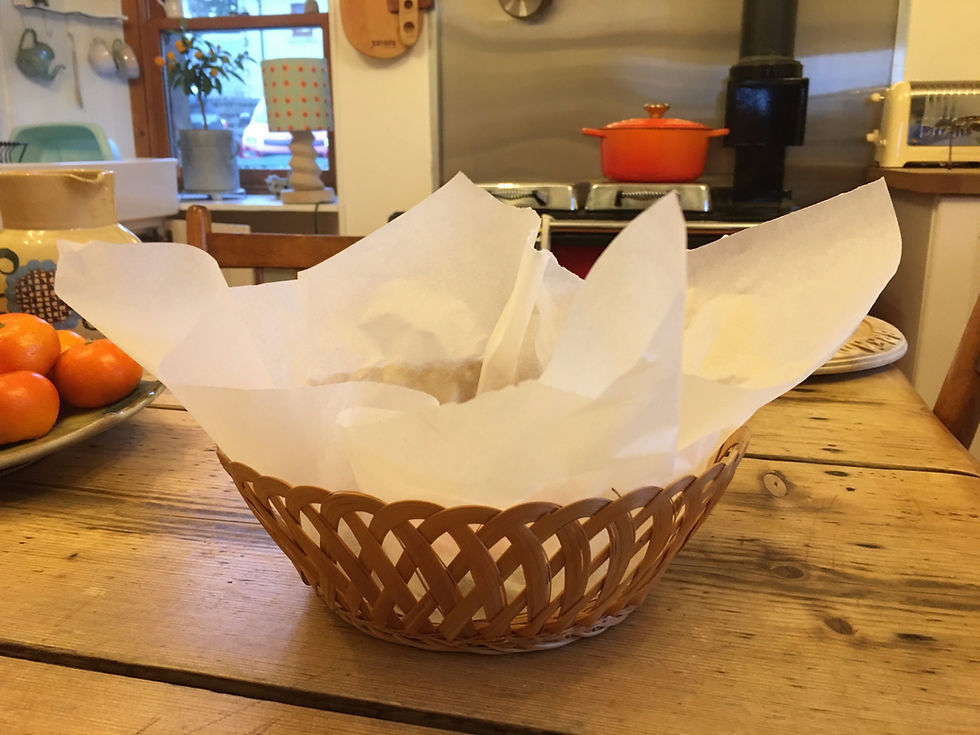
The method I chose to use was to put my cast iron dutch oven into the stove and get it as hot as it would get. I then simply lifted the dough out of the baskets in the grease proof paper and put it into the dutch oven and then put the whole thing into the stove with the lid on. I baked them for 20 minutes and then a further 20 minutes with the lid off to crisp the loaf crust.

Looks like artisan sourdough, smells like artisan sourdough and I had some for my breakfast this morning and you guessed it, it tastes like artisan sourdough bread!


Well done Catherine, how did they taste? I am using a teaspoon of pineapple juice in my starter each time I feed it. I heard it improves the fermentation. It might be the citric acid that help the yeast to grow. That is the case with country wine and mead. I just froze some juice in ice cubes and defrost one when I need it. I am baking my second batch this evening.
Coincidentally I have just made my first sourdough bread too. I had defrosted some frozen grapes to make space in my freezer and left some of the juice sitting in the heat of the kitchen for a couple of days. It started to ferment. I was reading a tweet from a biologist whose specialty is yeasts telling folk what to do if they couldn't get yeast to make bread. I realised that I could use the fermenting grape juice to make a starter for making sourdough bread. A couple of days later......
Both oven cooked one on a pizza stone and the other in a casserole dish. Not the prettiest looking loaves but I was amazed how well the grape…
No, then it would just be bread! Sourdough gets its name from the pleasant, slightly sour taste from the wild yeast fermenting in the starter jar.
Well done. Why is it called sourdough. Could you make sourdough with shop bought yeast